
Terminology management
What is terminology management? A practical guide
 Anita Racz
· 3 min read
Every organization speaks its own language: product names, feature labels, regulated phrases, internal jargon. When nobody manages that language, every writer, translator and market invents its own version of it. Terminology management is how you stop that from happening.
A definition
Terminology management is the process of collecting, reviewing, approving, publishing and governing the key terms of an organization, usually in a mono-, bi- or multilingual terminology database, or termbase. A good termbase stores more than words: each entry carries metadata such as a definition, usage notes, the product or domain it belongs to, and whether a term is preferred or forbidden.
In a wider sense, terminology management also covers the workflows around the termbase, its integration into your technology stack, and the business processes that keep it current.
Why it matters
Unmanaged terminology rarely shows up as a line item, but you pay for it everywhere:
- The same feature has three names across your website, user interface and documentation.
- Translators send the same queries project after project, and reviewers fix the same terms in every QA cycle.
- Translation memories fill up with competing variants, so leverage drops and costs rise.
- In regulated industries such as medical devices, an inconsistent term on a label is a compliance risk, not just a style issue.
In my consulting work, centralizing terminology databases, workflows and processes reduced translation costs by an average of 27%. Adding an integrated review tool on top eliminated two post-translation QA cycles for one client.
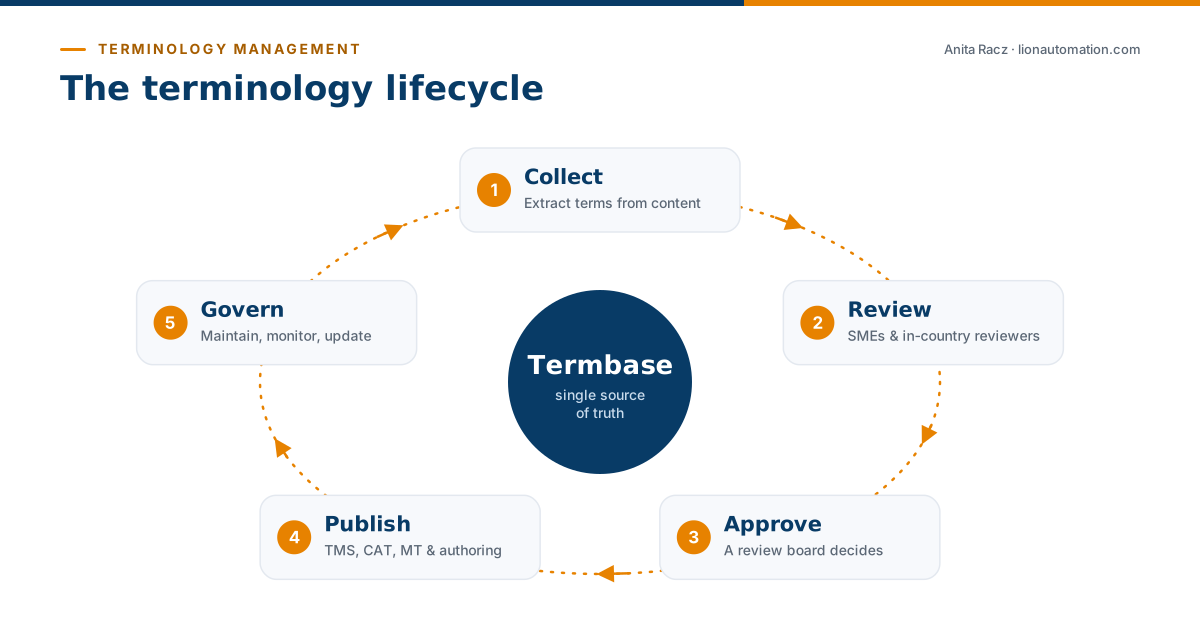
The terminology lifecycle in five steps
Terminology management is not a one-off glossary project. It is a cycle that repeats as products, markets and messaging evolve.
- Collect. Extract candidate terms from source content and existing glossaries. Extracting terms before translation starts keeps terminology changes out of late QA cycles.
- Review. Subject matter experts, linguists and in-country reviewers check meaning, usage and target-language equivalents.
- Approve. A defined decision path, ideally a cross-functional terminology review board, approves terms and marks rejected variants as forbidden. At BD, I founded and led such a board to institutionalize how terms were mined, proposed, reviewed and approved.
- Publish. Approved terms flow into the tools where people work: translation management systems, CAT tools, machine translation and authoring assistants, plus easy read-only lookup for everyone else.
- Govern. Owners maintain and monitor the termbase, add terms for new launches and rebrands, and retire outdated ones.
Who owns terminology?
Terminology touches Localization, Documentation, R&D, Marketing, Legal and Sales, which is exactly why it often belongs to nobody. Successful programs define ownership and decision paths up front: who can propose a term, who approves it, and how global and regional needs are balanced. This governance layer is what separates a living termbase from yet another spreadsheet.
How to get started
Start small and visible. Pick one product line or content type where terminology causes the most queries or rework, consolidate the existing lists, and prove the value there. Then scale. If you need budget first, read how to build the business case for terminology management. For the data side, see termbase vs. glossary.
Frequently asked questions
What is the difference between a termbase and a translation memory?
A translation memory stores previously translated sentence pairs. A termbase stores concepts and their approved terms in every language, with metadata such as definitions and usage status. Translators use both: the memory for reuse, the termbase for consistency.
Is terminology management only for translation teams?
No. Writers, marketers, support, sales and legal teams all benefit from consistent terminology at source. The earlier terms are fixed, the cheaper every downstream language becomes.
How long does it take to set up terminology management?
A focused pilot on one product line can show results within weeks. An enterprise-wide program usually runs in phases: business case, discovery, proof of concept, implementation and ongoing management.