
Business case
Terminology management ROI: how to build the business case
 Anita Racz
· 3 min read
Terminology programs rarely fail because the idea is wrong. They fail because nobody approves the budget. A credible return-on-investment calculation turns “consistency is good” into a decision your leadership can sign.
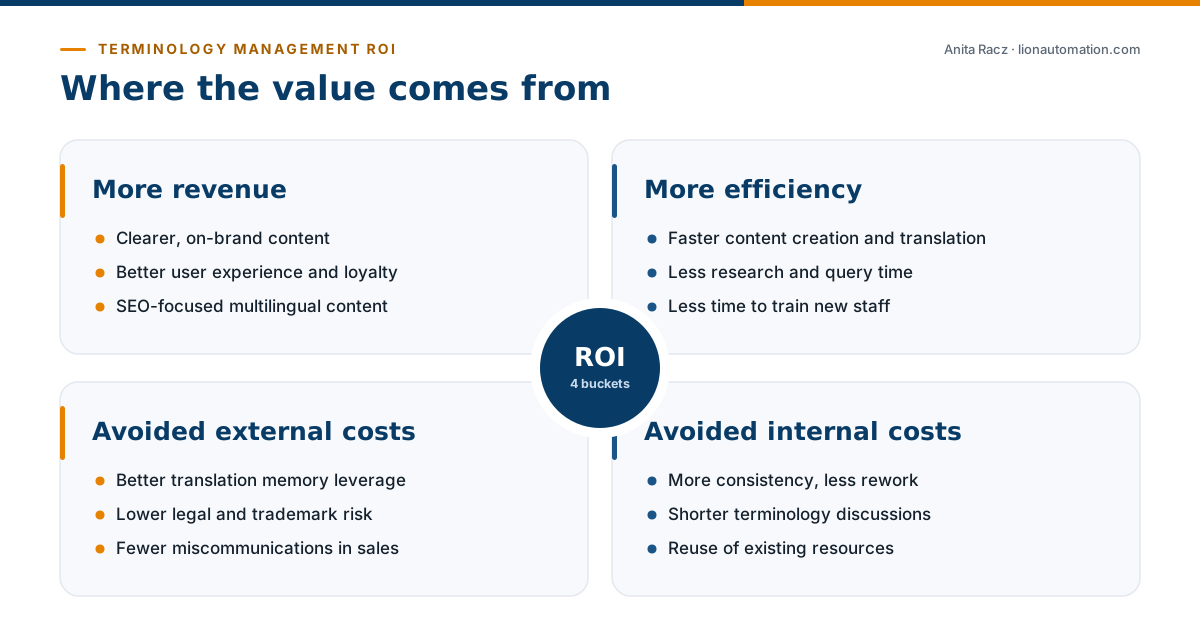
The four buckets of value
I have interviewed stakeholders in Localization, Documentation, R&D, Legal and Marketing at multinational organizations to calculate the ROI of terminology programs. The pain points are remarkably similar across departments, and the benefits fall into four buckets:
- More revenue: clearer, on-brand content, a better user experience that builds customer loyalty, and SEO-focused multilingual content that is easier to find.
- More efficiency: faster content creation and translation, less research and query time, and better cross-functional collaboration.
- Avoided external costs: better leverage of translation memories, lower risk of legal issues or trademark misuse, and fewer miscommunications in the sales process.
- Avoided internal costs: more consistency and less rework, shorter terminology discussions, and reuse of existing resources instead of creating new content.
One benefit comes up in almost every interview, regardless of role: less time spent training and retraining employees, because the termbase answers questions that used to require a colleague.
A five-step ROI method
- Identify beneficiaries and sponsors. Which business areas gain most from managed terminology, and who will fund it?
- Interview key stakeholders. Ask about current challenges and what consistent terminology would be worth to their team. Collect numbers: query volumes, review hours, rework cycles.
- Analyze benefits per department. Map each pain point to one of the four buckets and estimate the time or money saved per year.
- Analyze costs. Include tool licences, implementation and clean-up, integration, internal time for reviewers and owners, and ongoing maintenance. Total cost of ownership matters more than the licence fee.
- Calculate and present. Compare annual benefits with costs, show the payback period, and present it in each department’s own language.
ROI = (annual benefits − annual costs) ÷ annual costs × 100%
What results can look like
Real numbers make a business case concrete. In terminology projects I led as a consultant for multinational clients:
- Centralizing the corporate terminology database, workflows and processes reduced translation costs by an average of 27%.
- Integrating the termbase into translation and authoring tools contributed to 14% faster time to market.
- Introducing an integrated review and editing tool eliminated two post-translation QA cycles.
Your numbers will differ, which is exactly why the calculation should use your own data rather than industry averages.
Tips for winning buy-in
- Lead with the pain stakeholders already feel, not with terminology theory.
- Propose a proof of concept on real data before a full rollout; it lowers the perceived risk. See how to choose a terminology management tool.
- Plan for governance costs: a termbase without owners loses value quickly, and decision makers know it.
Frequently asked questions
How do you measure the ROI of terminology management?
Quantify time and money saved per department (queries, research, review cycles, rework, translation memory leverage) and compare it with the full cost of tools, implementation and maintenance.
Who should sponsor a terminology program?
Usually the department with the most visible pain, often Localization or Documentation, with support from Marketing, Legal or R&D. Cross-functional sponsorship makes governance easier later.
How quickly does terminology management pay off?
It depends on content volume and the number of languages. Organizations translating into many languages tend to see savings faster, because every fixed source term saves effort in every target language.